You’re Not a Victim
“Victim” is a trap. It’s a self-imposed prison.
“Victim” is an identity that people choose, not an objective state of being.
No one can make you a victim except you.
Now, I want to make it clear upfront that this doesn’t mean you can’t be really affected by bad things that have happened to you. You may be left metaphorically or literally bloody, bruised, and broken.
But “Victim” isn’t caused by injuries. It is caused by how you choose to respond to them. You may need to take time to heal, and to struggle through that process (I certainly have). You may need to learn to set firm boundaries. You don’t need to be a victim to deserve taking care of yourself. You don’t need to do or be anything to deserve taking care of yourself.
“Victim” is a way of orienting yourself to the rest of the world that says everything happens to you. Nothing is your fault or your responsibility, and more importantly, nothing is within your control. It’s profoundly disempowering.
The Karpman drama triangle illustrates how the victim orientation impacts relationships.
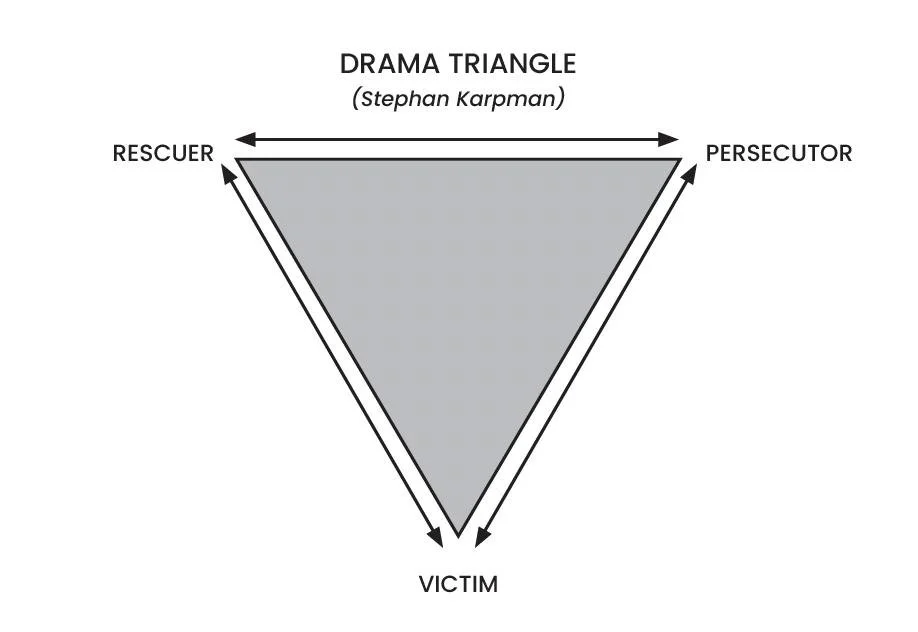
The drama triangle is comprised of Victims, Persecutors, and Rescuers. The role a person takes in the drama triangle is fluid, and perspective and context dependent. A person may feel like a Victim and be reacting from that point of view, and another person may be viewing them as a Persecutor. One Victim’s Rescuer can be another’s Persecutor, and so on. This is the trap so many people fall into during divorce. They both feel like Victims and look to each other like Persecutors.
This forms an endless loop of conflict.
During the lead up to my own divorce 8 years ago, I was stuck in the drama triangle in all areas of my life. As a divorce lawyer, I whole-heartedly embraced the role of The Rescuer and enabled my clients’ victim orientation. I owned their problems as my own, which came at a huge personal cost to me, and robbed them of the opportunity to find real solutions.
In my personal life I was the Victim, although I didn’t realize it at the time.
I didn’t actually learn of the drama triangle until several years after my divorce when I was in coach training. I was already struggling through an intuitive battle to get myself out of my victim identity, and the visual helped to concretize what I had been experiencing in my life and work. I remember my first thought when I saw it was, “well, shit.” “Rescuer” was practically flashing in neon lights. That’s an element of the dynamic I hadn’t recognized on my own.
I really started to move out of the drama triangle simply by being aware of it, which is one of the reasons why I’m sharing it here. But I was feeling like I wanted something more proactive than “Victim” avoidance. I wanted to embrace an identity that felt empowering. I stumbled across the book The Power of TED: The Empowerment Dynamic, a short and cheesy parable that provided just that.
This book very simply frames an alternative to the drama triangle that I really resonate with. It imagines a corollary dynamic to offset the roles of the drama triangle. Victims become Creators, Persecutors become Challengers, and Rescuers become Coaches.
Creators are empowered because they know they are fully in control of creating their own lives. They may run into people or circumstances that are frustrating, annoying, or even painful, but they know that they will learn and grow from these challenges. They may need some help along the way, but they can engage the assistance of Coaches and guides who can share wisdom and resources but who aren’t going to own the problem solving for them.
This framework was a real revelation to me. It allows me to see people and circumstances that in the past would have felt like Persecutors instead as Challengers who are helping me learn and grow. With this perspective, I’m able to look back on so many difficult experiences with genuine gratitude, and to navigate current challenges with more resilience and optimism.
When I encounter Challengers now, which I often do, I start by asking myself, “what does this person/situation have to teach me?” From that answer I can decide what action I want to take with a growth mindset instead of reacting from anger or fear.
A critique I could expect of this mindset is that it doesn’t apply to truly awful circumstances that are truly out of someone’s control. While I haven’t run into any experience yet which it doesn’t help, I certainly don’t have the receipts to fully put that criticism to rest. But I can borrow from a definitive expert on the matter and say:
“Everything can be taken from a [person] but one thing: the last of the human freedoms—to choose one’s attitude in any given set of circumstances, to choose one’s own way.”
― Viktor E. Frankl, Man's Search for Meaning
